
The Wheels Keep on Turning
Despite fewer deals, capital continues to flow toward companies solving real-world problems. This month we unpack the latest supply chain investment trends and highlight notable mobility developments.

Welcome to The Paddock, your go-to place for the latest insights and trends revolutionizing the mobility sector globally. 🚗
— Curated by Rodolfo and Enrique: the Proeza Ventures team. 💪
📌 Do you know a startup reshaping mobility by being more efficient, safer and environmentally friendly? We want to meet them! 📩
🏁 Check our investment thesis and learn more about our Portfolio Co.
🏆 Our PortCos News
💣 Bliq receives first of its kind driverless authorization in the EU
Bliq reached an important milestone on the road to autonomous mobility after receiving approval to operate fully driverless vehicles on public roads in Estonia under remote supervision—the first authorization of its kind in the European Union. The achievement validates both the company’s technology and its regulatory-first approach, positioning Bliq at the forefront of Europe’s autonomous driving landscape. As the company expands beyond Estonia, it marks another step toward making driverless mobility accessible to consumers and businesses across the continent.
👉Read the full announcement here.
🔋 Xos launches Power Hub to deliver grid-independent energy storage for data centers
Xos announced the launch of its new 2.5 MWh Power Hub, a containerized energy storage solution designed to deliver grid-independent power to data centers, industrial facilities, and other energy-intensive applications. As AI-driven power demand continues to surge and grid interconnection timelines stretch from years to months, the ability to deploy megawatt-scale power infrastructure in days is becoming an increasingly valuable capability. The announcement highlights the growing convergence of mobility, energy storage, and digital infrastructure as companies race to meet the next wave of electricity demand.
👉Read more here.
🚚 Cargado continues to remove friction in cross-border logistics
Cargado recently shared a case study highlighting how Direct Connect Logistix leveraged its platform to accelerate growth in cross-border freight. By gaining access to a trusted network of carriers and real-time market intelligence, the company increased its Mexico shipment volume by 88% while reducing quoting times from days to minutes. The results underscore a broader trend across North American logistics: as U.S.-Mexico trade continues to expand, technology and data are becoming critical differentiators for brokers, forwarders, and 3PLs looking to win and retain cross-border business.
👉Learn more here.
🚲 Ridepanda’s subscriptions increase on the back of high gas prices
As rising fuel costs put renewed pressure on commuters, employers are increasingly looking for alternative ways to reduce transportation expenses for their workforce. A recent Fast Company feature highlighted Ridepanda’s growing momentum as companies such as Amazon, Google, and Axon expand access to employer-sponsored e-bike and scooter subscriptions as a workplace benefit. Subscriber growth accelerated significantly during the recent spike in fuel prices, underscoring how quickly consumer behavior can shift when practical, affordable alternatives are available.
The story also reinforces a broader trend we’ve been watching for several years: micromobility is evolving from a consumer product into an employee benefit and transportation infrastructure solution. As companies continue to navigate return-to-office initiatives, parking constraints, sustainability goals, and employee retention, programs that reduce commuting friction are becoming increasingly relevant.
👉Learn more here.
📯 Hot Deals
At Proeza VC we check many deals weekly. Here are the Top deals that caught our attention recently!
🚀 A&K Robotics, a Vancouver, Canada-based developer of self-driving vehicles for people with mobility challenges, raised $8 million CAD in Series A funding. BDC Capital and Vantage Futures led the round (Apr.21.2026).
🚀 Aboard, a Southern California-based startup developing extended-range electric travel trailers, raised $13 million in a pre-Series A round led by Ondine Capital and Llama Ventures (May.21.2026).
🚀 Alitheon, a Bellevue, Washington-based startup that develops a physical asset ID technology for supply chains, raised $8 million in a round led by Emerald Technology Ventures with participation from eBay (June.2.2026).
🚀 Anello Photonics, a Santa Clara, CA-based startup which focuses on navigation technology for autonomous systems, raised a $25 million Series B-2 led by MESH (May.4.2026).
🚀 Antioch, a NY-based startup that develops simulation software that enables robotics companies to train and test autonomous systems in high-fidelity virtual environments, raised $8.5 million. The round was led by A* and Category Ventures, with participation from MaC Venture Capital, Abstract, and others (Apr.16.2026).
🚀 Bluelabs, a Miami-based global supply chain and manufacturing partner serving leading airlines, distributors, hospitality groups, and retailers, raised a $7 million round led by Lodestone Capital (May.27.2026).
🚀 Canals, a Miami, FL-based startup that offers a platform for industrial supply chain distribution workflows, raised a $35 million round led by Base10 Partners (May.29.2026).
🚀 Circuit, a Texas-based EV shuttle startup, raised $17 million led by MKB, with support from Tribecca Venture Partners and Impact Engine (May.18.2026).
🚀 Cloneable, a Raleigh, NC-based company that develops an agentic AI platform that captures expert knowledge and automates complex industrial workflows across infrastructure sectors, raised a $4.6 million Seed round led by Congruent Ventures (Apr.23.2026).
🚀 Corvera, a San Francisco-based startup that automates supply chain workflows for consumer-packaged goods brands by using AI to execute tasks across existing ERP and logistics systems, raised a $4.2 million seed round led by 6 Degrees Capital, with 20VC, Rebel Fund, and others (May.5.2026).
🚀 Crewline, a San Francisco-based developer of self-driving technology for already-built construction vehicles, raised $7.1 million in seed funding. Initialized Capital and Nebular led the round (Apr.22.2026).
🚀 Critical Loop, an LA-based startup that develops integrated power infrastructure platforms combining microgrids, battery storage, and software-defined controls to accelerate grid interconnections, raised $26 million in its Series A led by Conifer Infrastructure Partners and Hanover (Apr.13.2026).
🚀 Decade Energy, a Paris-based startup building power infrastructure at logistics depots, raised €22 million in a round led by Eiffel Investment Group and SET Ventures (Apr.24.2026).
🚀 Encosa, a Munich-based startup that offers BESS as a complete solution handling planning, financing, installation and operation, raised $25 million led by Realyze Ventures with participation from Verve Ventures, Blum Ventures, and others (Jun.1.2026).
🚀 Humble, a San Francisco-based startup that makes autonomous electric freight trucks, raised a $24 million seed round led by Eclipse and Energy Impact Partners (Apr.23.2026).
🚀 Loop, a San Francisco-based startup that uses AI to analyze supply chain data and predict disruptions, raised a $95 million Series C round co-led by Valor Equity Partners and the Valor Atreides AI Fund, with 8VC, Founders Fund, Index Ventures, and J.P. Morgan Growth Equity Partners also participating (Apr.17.2026).
🚀 Mobility Signage, a Munich-based startup that connects and standardizes transit data across legacy systems to deliver consistent real-time passenger information, raised a $2.1 million pre-seed round led by High-Tech Gründerfonds, and 2bX (May.4.2026).
🚀 Moment Energy, a Coquitlam, B.C.-based manufacturer of battery energy storage systems, raised $40 million in Series B funding. Evok Innovations led the round and was joined by Liberty Mutual (May.5.2026).
🚀 Nox Mobility, a Berlin-based startup developing private-room overnight trains in Europe, raised a $2 million pre-seed round led by IBB Ventures (Apr.22.2026).
🚀 Nyobolt, a Cambridge, U.K.-based fast-charging energy technology company, raised $60 million in Series C funding. Symbotic led the round and was joined by IQ Capital, Latitude, Scania Invest, and CBM (May.6.2026).
🚀 Pitz, a Mexico City-based startup raised $5M to expand its AI platform for mechanical workshops into Brazil and the U.S. The round included Alaya, Boost, Cracks, and Latitud (May.20.2026).
🚀 Rocsys, a Rijswijk, Netherlands-based developer of hands-free charging technology for autonomous electric vehicles, raised $13 million in a Series A extension. Capricorn Partners led the round and was joined by Scania Invest, Forward.One, and others (Apr.30.2026).
🚀 Scout AI, a Sunnyvale, CA startup that trains AI models to control autonomous vehicles and drones for military logistics, reconnaissance, and command-and-control tasks, raised a $100 million Series A round co-led by Align Ventures and Draper Associates (Apr.29.2026).
🚀 Sepion Technologies, an Alameda, CA startup that develops polymer coatings for battery separators that improve energy density, charging performance, and safety, raised a $10 million Series B round led by Fine Structure Ventures, with W. L. Gore & Associates, Syensqo Ventures, Volo Earth Ventures, Chailease, Catalus Capital, Impact Science Ventures, and ACVC Partners also investing (Mar.26.2026).
🚀 Smart Robotics, a Netherlands-based company focused on intralogistics automation, secured €10 million Series A led by Rotterdamse Havendraken (Apr.21.2026).
🚀 Synera, a Germany-based AI platform orchestrating the full industrial engineering value chain, raised a $40 million Series B led by Revaia, with participation from Capgemeni, UVC Partners, BMW iVentures, and others (Apr.14.2026).
🚀 Wayve, a UK-based startup that uses end-to-end neural networks trained on sensor data rather than maps or fixed hardware to power autonomous driving systems, raised a $60 million Series D extension. Investors included AMD, Arm, and Qualcomm (Apr.15.2026).
🚀 Zūm, a Redwood City-based startup whose platform is designed to coordinate school transportation by managing routing, dispatch, and communication in real-time, raised a $100 million round at a $1.7 billion valuation. TPG was the deal lead (Apr.16.2026).
📗 Interesting Reads
🤖 Supply Chain Tech: Fewer Bets, Bigger Convictions
At first glance, the logistics venture market appears to be slowing down. Global logistics VC deal count fell to just 71 deals in Q1 2026, continuing a multi-year decline from the nearly 900 deals completed during the 2021 peak. Seed and early-stage activity has been particularly affected, with only 16 seed and early-stage deals completed during the quarter, the lowest level since 2018. Yet beneath the headline numbers lies a more nuanced story: investors remain willing to write large checks for companies solving mission-critical supply chain problems.
Total logistics venture funding reached $19.3 billion in Q1, though the figure was heavily influenced by Waymo’s $16 billion financing round. Excluding that transaction, the market still generated approximately $3.3 billion of investment activity, representing 59% quarter-over-quarter growth and 74% year-over-year growth. In other words, while investors are becoming more selective, conviction remains high for businesses demonstrating clear product-market fit and tangible customer value.
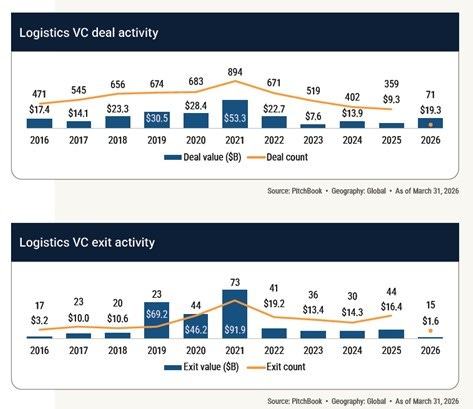
The quarter also highlighted where investors are placing their bets. Freight tech captured nearly $17 billion of capital, while warehousing technology experienced a resurgence, attracting nearly $500 million across 14 deals, its strongest funding quarter since 2022. Companies focused on warehouse automation, robotics, AI-driven planning, and transportation software continue to benefit from a simple reality: supply chains have become too complex and volatile to manage with yesterday’s tools. In fact, transportation software was one of the strongest-performing segments in PitchBook’s analysis, as shippers increasingly seek real-time visibility, dynamic routing, compliance automation, and AI-powered decision-making capabilities.
Perhaps the most important takeaway is that resilience has become the new efficiency. Geopolitical tensions, tariff uncertainty, labor shortages, and energy volatility are forcing companies to redesign how they move goods around the world. As a result, supply chain technology is no longer viewed merely as a cost-saving tool but as strategic infrastructure. The winners over the next decade are likely to be the companies that help enterprises navigate uncertainty, automate decision-making, and build more adaptable supply networks—an investment theme we believe remains firmly intact despite the market’s more selective pace.
Other relevant news
Where did all the affordable cars go?
Pittsburgh startup tests robotaxi parking payment system.
BYD offers full coverage for your self-driving vehicle.
What would it take to rebuild US manufacturing might?
Predictive maintenance unlocks key to mocromobility profitability.
Cops can ticket driverless cars now.
Uber to collect data for its robotaxi partners.
🌱 Opportunities in Mobility
👩🏻💻Strategic Growth Manager - BusUp
👩🏻💻Customer Engagement Manager - Deftpower
👩🏻💻Security Officer, eMobility - Deftpower
👩🏻💻Director of Engineering - Buzz Solutions
👩🏻💻Product Manager - Buzz Solutions
👩🏻💻Operations Analyst - Coral
That's it for this month!
Don't forget to subscribe or forward The Paddock to your friends in the mobility sector! 🏍️💨